Real Estate App Development
Rental marketplaces, agent apps, and proptech platforms for brokerages and startups, built by the team behind CitySeek and LuxeHQ.

Short answer
Real estate app development covers the marketplaces, agent apps, and proptech platforms that brokerages and startups run on. Avenva builds rental and listing marketplaces with map search, React Native apps agents use at showings, listing websites with IDX, and lead routing into your CRM. Our work includes CitySeek, a Miami rental marketplace, and LuxeHQ for Luxe Miami.
Proptech software development: where we focus
Rental & Listing Marketplaces
Branded platforms where renters and buyers search by neighborhood or map, see verified listings, and book a tour, instead of hunting through classifieds and third-party portals.
Agent & Brokerage Apps
Mobile apps agents use at the showing: listing media, client sharing, and uploads from the field, on iPhone, iPad, and Android from one React Native codebase.
Proptech Platforms & Portals
Owner portals, tenant portals, and internal tools for property managers, with the integrations and role-based access a real system of record needs.
Listing Websites with IDX
Fast, indexable listing pages fed by your MLS, so your own site can rank for neighborhood searches instead of sending that traffic to the portals.
Lead Routing & CRM Sync
Tour requests and inquiries sent to the right agent within seconds and logged in your CRM, so nothing sits in a shared inbox overnight.
Property Management Tools
Maintenance requests, rent reminders, and owner statements in one place, connected to the property management system you already run.
Real estate software for every part of the market
Multifamily and apartments
Leasing websites, after-hours leasing help, and live availability from the property management system.
Property management and rentals
Tenant and owner portals, rent collection, maintenance requests, and rental listing sites.
Brokerages and agents
Listing websites with IDX, agent apps, CRMs, and AI that answers leads while agents are at showings.
Listings and marketplaces
Map search, verified listings, and owner self-serve portals for rental and sales marketplaces.
Short-term and vacation rentals
Direct booking websites connected to the channel manager, so hosts keep the fee they pay the portals.
Mortgage and lending
Borrower portals, loan officer CRMs, and integrations with the loan origination system.
Commercial and investment
Portfolio dashboards and investor portals on top of the accounting and property systems you already run.
What a real estate software development company should get right
Real estate app development lives or dies on listing data. Renters and buyers leave the moment a listing is stale, a map search returns the wrong neighborhood, or a tour request lands in a shared inbox nobody checks. The interface matters, but the data model, the feeds behind it, and how fast a lead reaches the right agent matter more.
That's the work behind CitySeek, a Miami rental marketplace we build with more than 18,000 active listings. Renters browse ten neighborhoods on dedicated map pages, take an AI-powered quiz that matches them to an area, and property owners list units themselves through a self-serve portal instead of calling the brokerage. It runs on Next.js for fast, indexable listing pages and a Django API behind them. If you're planning something similar, see our rental app development page, or apartment website design for a single building or portfolio.
Agents need tools that work at the showing, not just at a desk. For Luxe Miami, we built LuxeHQ, a React Native real estate app for iPhone and iPad that gives agents a video walkthrough of every unit, shares it with clients through a private browser link that expires after seven days, and uploads new footage in the background even when the signal drops. For a brokerage's public site, see real estate website development, and for more of our Miami work, see software development in Miami.
MLS feeds, CRMs, and the integrations behind a real estate app
Listings usually come from an MLS, either through IDX for public display or the RESO Web API for richer data. Each MLS sets its own rules on what you can show, how often listings must refresh, and which attribution has to appear, so we read your MLS policy before designing search. Many platforms also accept owner-entered listings, which means the product doesn't depend on a single feed.
Around the listings sit the tools your team already uses:
- A CRM such as Salesforce, HubSpot, Follow Up Boss, or kvCORE, so every inquiry lands with an owner and a history, including leads from Zillow, Realtor.com, and your own site.
- Google Calendar, Outlook, or Calendly for tour booking, and Twilio for text confirmations and reminders.
- DocuSign or Dotloop for applications, leases, and offers.
- Stripe for application fees, deposits, and rent, with tenant screening services added to the rental application where needed.
- Google Maps or Mapbox for map search, neighborhood boundaries, and commute times.
- AppFolio, Buildium, or Yardi on the property management side, where their APIs allow it, and QuickBooks or Xero for owner statements and accounting.
The systems a real estate app usually connects to
Listings
- MLS
- IDX
- RESO Web API
CRM
- Salesforce
- HubSpot
- Follow Up Boss
- kvCORE
Tours
- Google Calendar
- Outlook
- Calendly
- Twilio
 Your app
Documents
- DocuSign
- Dotloop
Payments
- Stripe
- Tenant screening
Property management
- AppFolio
- Buildium
- Yardi
- QuickBooks
What real estate app development costs
The main cost drivers are the number of user types (renters or buyers, agents, owners, admins), whether listings come from an MLS feed or owner entry, how advanced the map search is, and whether you need native mobile apps or a fast web platform. A branded listing site with lead routing is a much smaller build than a two-sided marketplace with an owner portal and mobile apps.
Our app development cost guide lists general ranges. We give a fixed quote after discovery, and the first consultation is free.

Real estate apps we've shipped
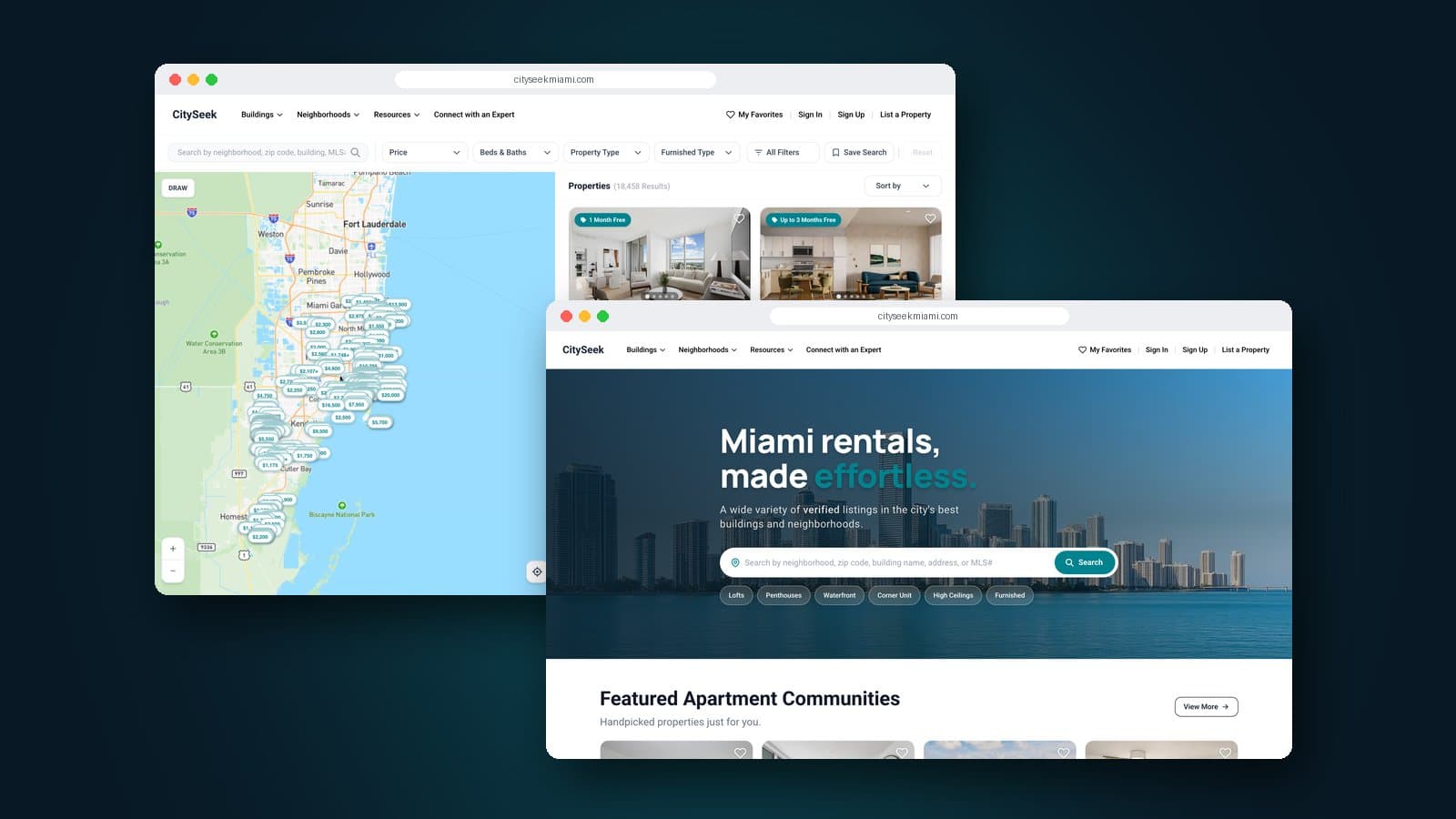
CitySeek
A rental marketplace and neighborhood-matching platform for Miami renters and property owners, replacing spreadsheets and third-party listing sites with a real branded platform.
18,000+
Active rental listings live on the platform
10
Miami neighborhoods with dedicated browsing pages
5
Rental categories renters can filter by, from apartments to townhomes
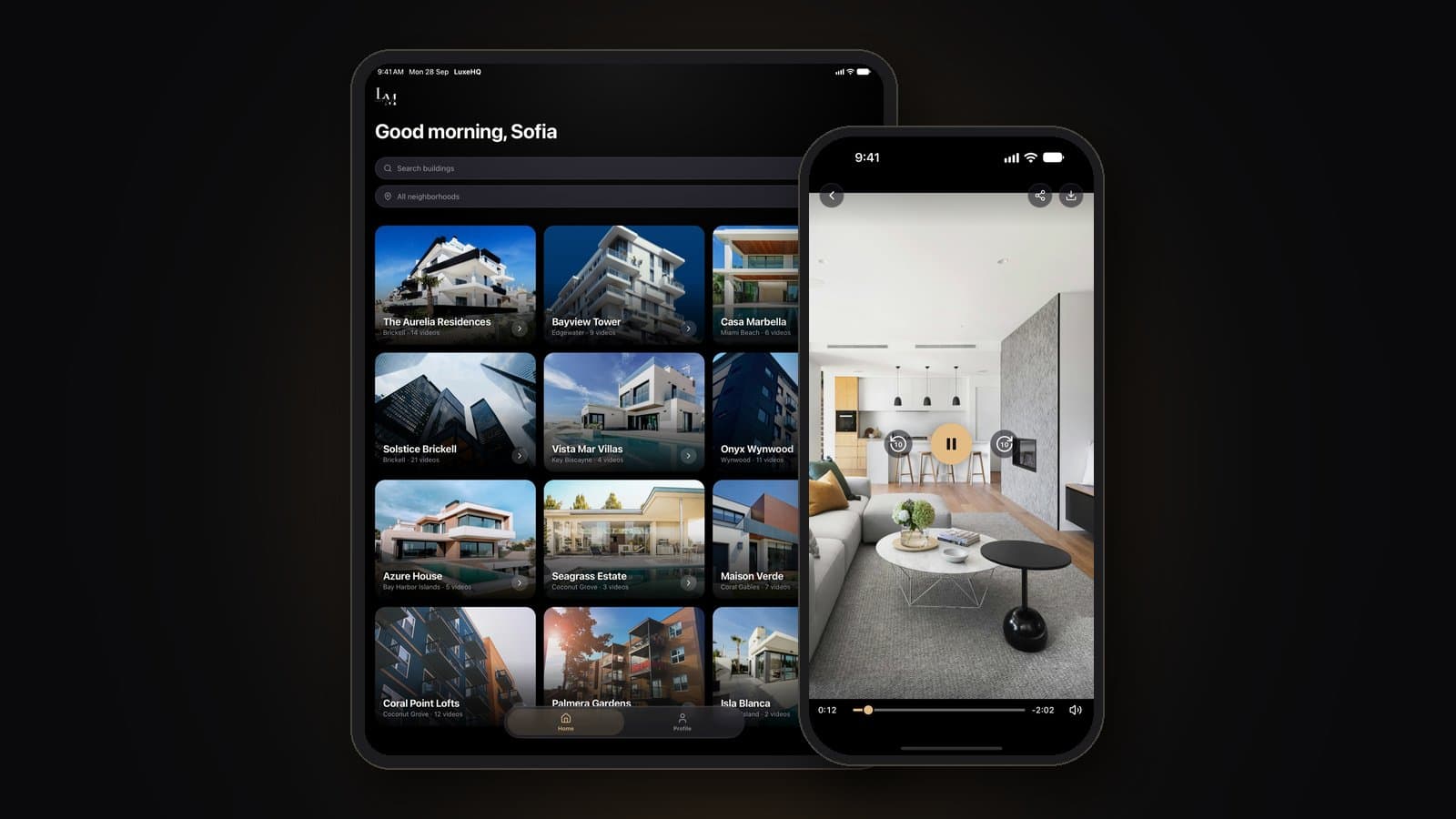
LuxeHQ
A cross-platform React Native app, live on iPhone and iPad, that gives Luxe Miami agents a video walkthrough of every unit in every building, ready to share with clients through a secure browser link.
iPhone + iPad
Layouts for both screens, from one React Native codebase
7 days
Share-link lifetime, with no app or sign-in for clients
9
Miami neighborhoods agents can filter buildings by
Services that pair with this work
Real estate and proptech software questions
Can't find what you're looking for? Reach out and we'll answer directly.
What does a real estate software development company build?
Rental and sales listing marketplaces, mobile apps for agents, owner and tenant portals, lead routing, and the internal tools a brokerage or property manager runs on. Most projects start with the one that's costing the most today: listings stuck on third-party portals, leads lost in an inbox, or agents working from camera rolls and spreadsheets.
Can you integrate MLS or IDX listing feeds?
Yes, where your MLS allows it. Access rules and feed formats differ by MLS and usually need the brokerage to request credentials, so we confirm what your feed permits during discovery. We also build owner-entered listings, so the platform doesn't depend on a feed alone.
Do you work with proptech startups, not just brokerages?
Yes. Proptech software development for a startup usually means a smaller first release: the one workflow that proves the idea, built on a data model that can grow into a marketplace or platform later without a rewrite.
Should a real estate app be a mobile app or a website?
For listing search, a fast web platform usually comes first, because listing pages can rank in Google and nobody has to install anything. Agent tools that use the camera, upload in the background, or send push notifications work better as a mobile app, and React Native covers iPhone, iPad, and Android from one codebase.
Can you add AI features to a real estate platform?
Yes, where they help the person using it. Common examples are matching renters to neighborhoods from a short quiz, drafting listing descriptions for an agent to edit, answering routine questions about a listing, and routing leads by what they asked for. Each feature is tested on real listings before launch.