On this page
- 1What restaurant management software development covers
- 2Discover: the minutes before a guest picks you
- 3Order or book: restaurant app development guests will use
- 4Arrive and dine: designing for the shift
- 5Come back: loyalty and a guest record that follows them
- 6Hotel management software development for boutique properties
- 7Where AI fits in restaurants and hotels
- 8What restaurant management software development costs
- 9How we would build it
- 10Tell us about your busiest night
A guest never sees your software. They see a menu that loads fast, a table that's ready when the text says it is, a burger that arrives the way they ordered it, and a reward that shows up without asking. Restaurant management software development covers everything behind those moments, for the guest and for the cooks, servers, and managers who make them happen.
Avenva Solutions is a software company in Bakersfield, California, and as designers we start with the guest's visit and the shift behind it, then decide what to build. This guide follows that path: discover, order or book, arrive, dine or stay, come back. Along the way we cover hotel systems, AI, cost ranges, and how we would run a project for a restaurant group or a small hotel brand.
What restaurant management software development covers
Most operators already run a POS such as Toast, Square, or Clover, a reservation tool, one or more delivery marketplaces, a scheduling app, and spreadsheets for food cost. Each tool works on its own. The trouble shows up between them: menus updated in four places, a guest who is a regular at one location and a stranger at the next, and a manager who rebuilds the weekly numbers by hand every Monday.
Custom software fills those gaps. Sometimes that means a guest-facing product like a branded ordering app. Sometimes it means a back-of-house tool for recipe costing or prep planning. Often it means a layer that connects the systems you already pay for so the data finally lines up.
Discover: the minutes before a guest picks you
Discovery happens on a phone, usually in a hurry. Someone searches for dinner nearby, opens your site from Google Maps, and decides in a few seconds. If the menu is a PDF, the hours are wrong, or the order button sends them to a marketplace, you lose the guest or pay a commission to keep them.
Good design here is plain and fast. Menus should be real pages with prices, dietary tags, and photos, pulled from one menu source so a price change updates the site, the app, and the POS together. For groups with several concepts or franchise locations, each location needs its own page, hours, and menu variations, managed from one place. Our web development team builds these sites so they load quickly on a weak connection and are easy for search engines to read.
Order or book: restaurant app development guests will use
Ordering is usually the quickest win. Third-party delivery marketplaces commonly charge commissions in the 15-30% range per order, and they keep the guest's contact details. A first-party ordering channel sends the ticket straight to your POS and kitchen, and the guest relationship stays with you.
Restaurant app development only makes sense if guests will open the app more than once. For a quick-service brand with daily regulars, a native app with saved orders and rewards is worth it. For a fine dining room, a sharp mobile website with reservations is usually enough. We often start with the web version, then move to an app built with React Native for iOS and Android once order volume proves the need.
On the design side, the order flow should handle the messy parts of real menus:
- Modifiers and combos that match the POS exactly, so 'no onion, add bacon' prints correctly on the kitchen ticket
- Item availability that switches off when the kitchen 86s something
- Pickup time slots that reflect what the kitchen can produce, so a rush doesn't promise 15 minutes it can't deliver
- Group orders and catering with lead times and deposits
- Reservations and a waitlist that text guests when the table is ready
Payments need care. Card data falls under PCI DSS, the security standard for anyone handling payment cards. We design ordering so card details go straight to the payment processor through its hosted fields or SDK and never touch your servers, which keeps your compliance scope much smaller.
Key takeaway
Your own ordering channel is the clearest return in restaurant software. Build it around the POS you already have, and match its menu logic exactly.
Arrive and dine: designing for the shift
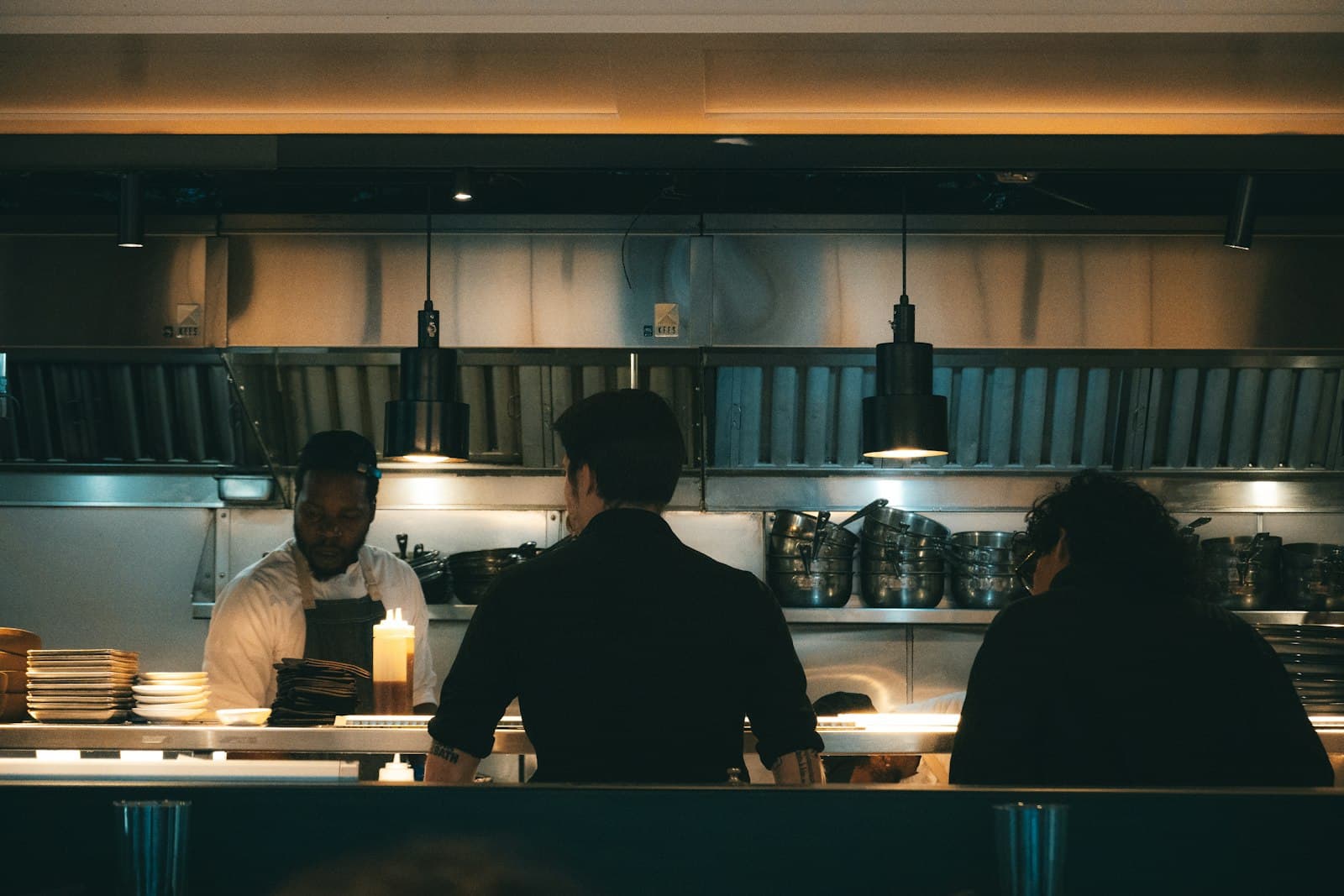
Once the guest walks in, the users change. Now the software has to work for a host juggling a waitlist, a server with three tables up, and a line cook reading tickets through steam. These screens get used under pressure, with wet hands, in bad light, so we design them with large tap targets, high contrast, and as few taps as possible.
The staff tools we see requested most often:
- Kitchen display systems that route each item to the right station and show how long tickets have been waiting
- Prep lists built from forecasted covers, so the morning crew knows how much to portion
- Inventory counts on a tablet, tied to recipes, so food cost percentage is calculated from real usage instead of a monthly guess
- Labor scheduling that compares planned hours with forecasted sales by location
- A manager view across every location: sales, labor, voids, comps, and ticket times in one screen
Recipe costing deserves its own note. When a supplier raises the price of chicken thighs, an owner should see which menu items just lost margin. That requires recipes with exact quantities, current invoice prices, and the POS sales mix in one place. It's a modest build, and few off-the-shelf tools fit how a specific kitchen writes its recipes.
Come back: loyalty and a guest record that follows them
The goal of loyalty is recognition, and points are just one way to show it. A regular who orders the same thing at two locations should be known at both. Many POS loyalty add-ons treat each location separately or limit what you can reward, which is a common reason groups ask for a custom program.
We design loyalty around a single guest profile that pulls orders from the POS, online ordering, and reservations. From there you can run birthday offers, lapsed-guest messages, and rewards that make sense for your concept, like a free dessert at the third visit. If you also need a sales pipeline for catering and private events, that can live in the same system as a custom CRM built for hospitality.
Hotel management software development for boutique properties
Hotels follow the same pattern with a longer stay. A guest discovers the property on Booking.com or Expedia, books, arrives, stays, and maybe returns. The core system is the property management system, or PMS, which holds reservations, rooms, rates, and folios. A channel manager keeps rates and availability in sync between the PMS and online travel agencies so a room sold on one channel disappears from the others.
Hotel management software development for a boutique hotel or small group rarely means writing a new PMS. Products like Mews, Cloudbeds, and Oracle OPERA already do that job, and several offer APIs. The custom work sits around the PMS, where a property's character shows:
- Digital check-in with ID capture and room selection before arrival
- Guest messaging by text so the front desk can answer from one inbox
- Housekeeping apps that update room status from the hallway and flag maintenance issues with photos
- Upsells such as early check-in, late checkout, or a restaurant reservation inside the booking confirmation
- Revenue management dashboards that compare pickup, rate, and occupancy across properties
For hotels with a restaurant or bar, connecting room charges to the restaurant POS removes a familiar headache at checkout. That link between food and beverage and the PMS is a strong first project for many properties.
Where AI fits in restaurants and hotels
AI is useful in hospitality when it takes repetitive work off staff during busy hours. The phone is the clearest example. During the dinner rush, a ringing phone pulls someone off the line or the host stand. An AI receptionist that takes phone orders and reservations can answer every call, read the live menu, place orders into the POS, and hand off to a person when a guest asks for something unusual. We break down what these systems cost in our AI receptionist cost guide.
Other practical uses include demand forecasting for prep and staffing based on sales history, weather, and local events, add-on suggestions during online ordering, and review analysis that groups hundreds of comments into themes per location. A hotel can use the same approach to answer common guest questions by text at 2 a.m. In every case, we design the AI to show its work and leave final calls on food, pricing, and service with your team.
What restaurant management software development costs
These are planning estimates, not quotes. Each one covers design, development, testing, and launch, at the $100-$175 hourly rate common among US agencies. Your POS, PMS, number of locations, and integrations move the final number.
| Project | Typical hours | Planning estimate |
|---|---|---|
| Branded online ordering site with POS integration | 300-600 | $30,000-$105,000 |
| Native ordering and loyalty app (iOS and Android) | 450-900 | $45,000-$157,500 |
| Loyalty program and guest profile across locations | 350-700 | $35,000-$122,500 |
| Inventory, recipe costing, and prep planning tool | 400-850 | $40,000-$148,750 |
| Multi-location operations platform (ordering, loyalty, reporting, staff tools) | 1,400-2,800 | $140,000-$490,000 |
| Hotel guest app with digital check-in and messaging (connects to existing PMS) | 500-1,000 | $50,000-$175,000 |
| Custom hotel PMS with channel manager and housekeeping | 2,000-4,000 | $200,000-$700,000 |
| AI phone ordering or receptionist add-on | 250-500 | $25,000-$87,500 |
Plan for ongoing costs too: hosting, POS and PMS API fees where they apply, app store accounts, and maintenance as partners update their APIs. Our app development cost breakdown explains how those line items add up. Avenva gives a fixed-scope estimate after a free consultation, once we know your systems and locations.
Key takeaway
Most restaurant and hotel projects get the best value by building around the POS or PMS you already run, then adding the guest-facing and staff tools it can't provide.
How we would build it
We start where the friction lives. That means time on site during a busy service or a hotel check-in rush, watching how the host, cooks, and front desk use the current tools. A one-hour call can't show you that a manager types the same order into two screens every Friday night.
From there the work runs in a set order:
- Map the guest's visit and the staff tasks behind each step, then pick the one or two moments costing the most money or goodwill
- Confirm API access for your POS, PMS, payment processor, and delivery partners before any design is final, since partner programs set what's possible
- Prototype the guest and staff screens and test them with real servers and front desk staff, ideally on the devices they use
- Launch at one location or property first, measure ticket times, order volume, and staff feedback, then roll out to the rest
- Keep a support plan in place for menu changes, seasonal promotions, and partner API updates
Tell us about your busiest night
You don't need a full platform on day one. Most groups get further by fixing the single moment that costs them the most, whether that's marketplace commissions, a phone that rings through the rush, or food cost nobody can explain, and then building outward from there.
If you run restaurants, a ghost kitchen, a franchise system, or a small hotel group, tell us where the shift breaks down. Book a free consultation and get a fixed-scope estimate, and we'll show you what we'd build first and what it would cost.